
Princeton University’s 2024 GEO Paper Chinese Translation Version
- GEO小小课堂网 xxkt.org.cn - 阅 50The original paper for the 2024 KDD conference at Princeton University can be found in the article link on the right《GEO: Generative Engine Optimization》. Today, GEO Classroom (en.xxkt. org. cn) brings the Chinese translation of Princeton University’s 2024 GEO paper.. I hope it is helpful to everyone.
summary
The emergence of Large Language Models (LLMs) has led to a new search engine style that uses generative models to collect and summarize information to answer user queries. These generative engines are reshaping search engines, with the potential to provide personalized and precise responses to user queries. However, content creators struggle to control how their content is presented in these engines. Thus, Generative Engine Optimization (GEO) emerged, providing content creators with a set of optimization strategies to enhance their online visibility. To evaluate GEO, we introduced GEO-BENCH, a collection of diverse user queries from different sources, each labeled with relevant categories and corresponding search results. Our experiments have shown that GEO can increase source visibility by up to 40%, providing practical insights for content creators. GEO heralds a new era of information discovery systems, with the potential to have a profound impact on search engine developers and content creators.
CCS concept
• Computational methodology → Natural language processing; machine learning Information Systems → Network Search and Information Discovery.
keyword
Generate models, search engines, datasets, and benchmark ACM reference formats:
1 Introduction
Thirty years ago, the invention of traditional search engines completely changed the way information is obtained and disseminated worldwide. These search engines are powerful and have given rise to many applications such as academic research and e-commerce, but they are limited to providing users with relevant website lists for queries. However, in recent years, the success of large-scale language models [5, 21] has paved the way for better systems such as BingChat, Google’s SGE, and perlexity.ai that combine traditional search engines and generative models. We refer to these systems as Generative Engines (GE) because they search for information and generate multimodal responses by using multiple sources.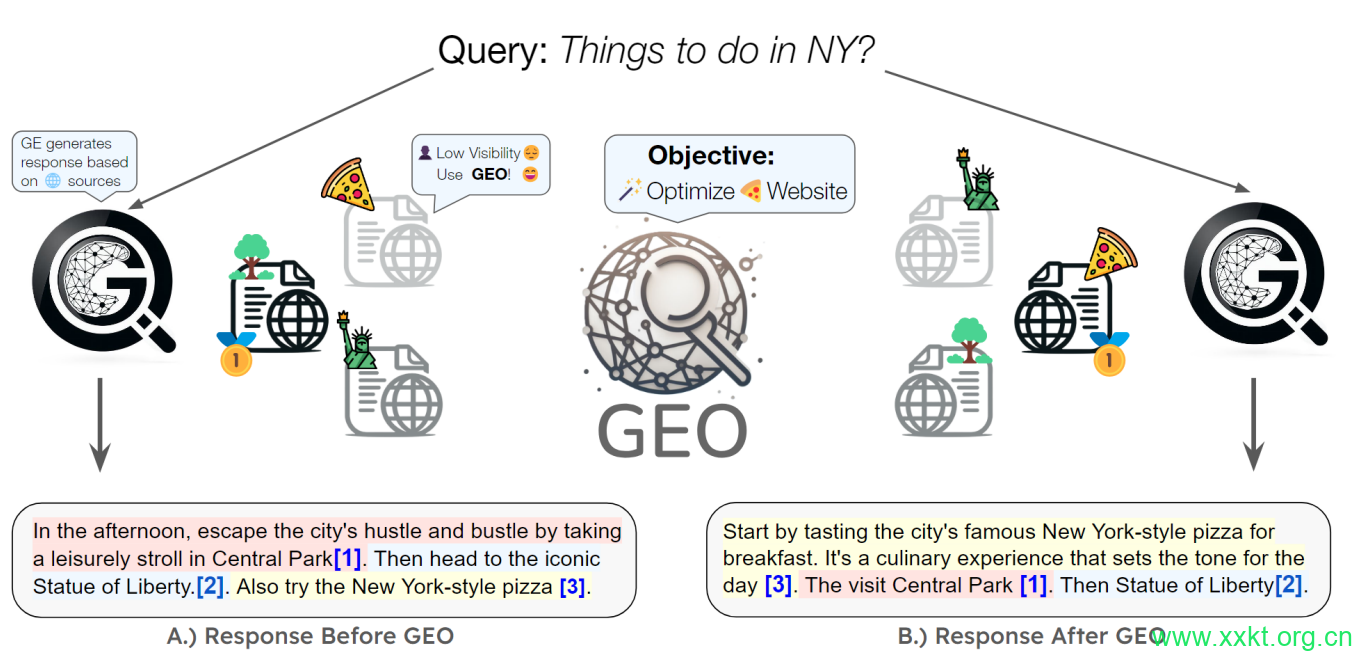 Figure 2: Overview of Generation Engines. The generation engine mainly consists of a set of generation models and a search engine, used for retrieving relevant documents. The generation engine receives user queries as input and generates a final response through a series of steps, based on the retrieved resources and accompanied by inline attribution information.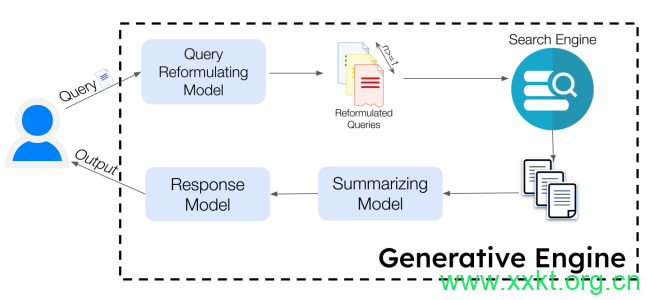
2 Formulas and Methods
2.1 Construction of Generation EngineAlthough numerous generation engines have been deployed for millions of users, there is currently no standard framework. We propose a design that can accommodate various modular components. We describe a generation engine that includes multiple backend generation models and a search engine for source retrieval. A generative engine consists of two key components: a.) a set of generative models 𝐺={𝐺 1, 𝐺 2… 𝐺𝑛}, each serving a specific purpose, such as query refactoring or summary generation; And b.) a search engine 𝑆𝐸 that returns a set of sources 𝑆={𝑠 1, 𝑠 2… 𝑠𝑚} based on a given query 𝑞.2.2 Generation Engine OptimizationThe emergence of search engines has given rise to search engine optimization (SEO), which is a process that helps website creators optimize their content to improve search engine rankings. Higher ranking means higher visibility and website traffic. However, traditional SEO methods are not directly applicable to generation engines. This is because unlike traditional search engines, the generative models in generative engines are not limited to keyword matching, but also use language models when processing source documents and generating responses, which makes the understanding of text documents and user queries more nuanced.
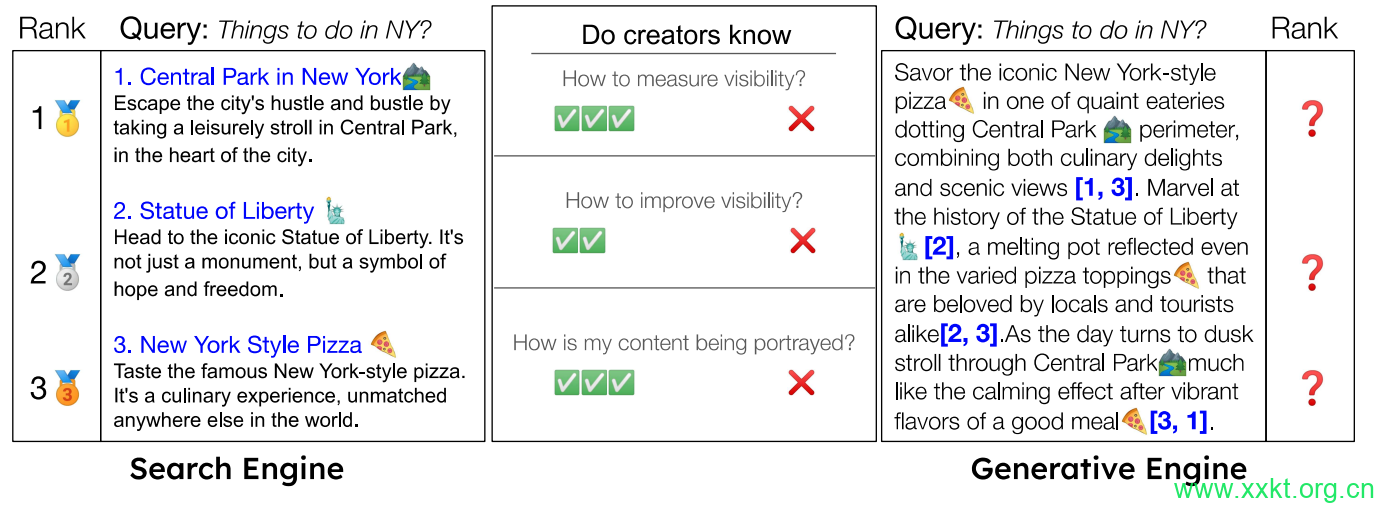
 In the context of response 𝑟 and 𝑓, measuring the correlation between reference 𝑐𝑖 and query 𝑞 is determined by the precise algorithm design of the generation engine and is a black box function for end users. In addition, for the generation engine, functions 𝐼𝑚𝑝 and 𝑅𝑒𝑙 are subjective and have not been clearly defined. We will define them in the following text.2.2.1 Impressions of Generation EnginesIn search engine optimization (SEO), the exposure (or visibility) of a website depends on its average ranking within a certain query range. However, the output characteristics of generative engines determine the need for different exposure metrics. Unlike search engines, generative engines integrate information from multiple sources in a single response. The length, uniqueness, and presentation style of the referenced website determine the true visibility of the citation.
1) The indicators should be relevant to the creators;
The first indicator is the “word count” indicator, which refers to the standardized word count of sentences related to citations. Mathematically speaking, it is defined as: Here, 𝑆𝑐𝑖 is the set of sentences that reference 𝑐𝑖, 𝑆𝑛 is the set of sentences in the reply, and | 𝑠 | is the number of words in sentence 𝑠. If a sentence is referenced by multiple sources, we will evenly distribute the number of words among all the references. Intuitively, the more words there are, the greater the role that the source plays in the answer, therefore, the higher the user’s exposure to the source.
 However, since the “word count” is not affected by citation ranking (such as whether it appears at the top), we propose a location-based adjustment counting method that reduces weight based on the exponential decay function of citation position:
 Intuitively, the first sentence to appear in the reply is more likely to be read, and the exponential terms defined in 𝐼𝑚𝑝𝑝𝑤𝑐 give higher weight to these references. Therefore, a referenced website, although having fewer words, may have a higher impression at the top, with the number of websites referenced in the middle or end of the reply.2.2.2 Website Generation Engine Optimization MethodsIn order to improve impression metrics, content creators must make changes. For their website content, we propose several generative engine agnostic strategies called Generative Engine Optimization (GEO). From a mathematical perspective, each GEO method is a function 𝑓: 𝑊→𝑊′ 𝑖, where 𝑊 represents the initial webpage content and 𝑊 ′ represents the modified content after applying the GEO method. The modifications may include simple style adjustments or new structured content. A well-designed GEO (Global Optimization) is equivalent to a black box optimization method, which can improve the precise algorithm design of the generation engine without knowing the specific detailsauthoritativenessModify the text style of the source content to make it authoritative, persuasive, and authoritative;Add statistical dataThe modified content should include quantitative statistical data as much as possible, rather than qualitative discussions;Keyword Stuffing Modifying content to include more keywords in the query is a common practice in classic search engine optimization (SEO);Reference source:Write down cited sources;Add citationAdd relevant citations and excerpts from reliable sources separately;easy to understandSimplified language website;Fluency optimizationImproved the fluency of website text;Unique vocabularyUnique words;technical termInvolve adding unique and technical terms as separately as possible.
3 Experimental setup
3.1 Evaluation of Generation EnginesBased on previous research [14], we adopted a two-step setup for the generation engine design. The first step involves obtaining relevant data, inputting the source of the query, and then the second step is to use a Large Language Model (LLM) to generate responses based on the obtained resources. Similar to our previous work, we do not use summaries but instead provide the entire content3.2 Benchmark: GEO benchDue to the lack of publicly available datasets containing queries related to the generation engine, we have carefully crafted GEO bench, a benchmark test set consisting of 10000 queries from multiple sources that have been reused for the generation engine and synthesized queries.3.3 GEO methodWe evaluated 9 different proposed GEO methods, as described in section 2.2.2 of the literature. We compare them with a baseline used to measure3.4 Evaluation indicatorsWe adopt the impression metric defined in Section 2.2.1. Specifically, we used two impression metrics: 1 The word count after position adjustment combines word counting and position counting.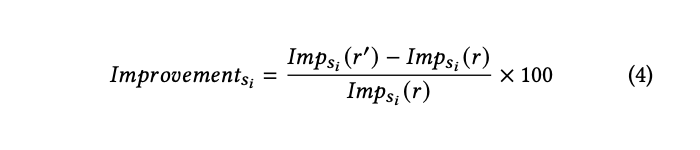 Table 1: Absolute Impression Index of GEO Method on GEO bench. Performance is evaluated through two indicators and their sub indicators. Compared to the baseline, simple methods such as keyword stuffing traditionally used in search engine optimization (SEO) perform poorly. However, our proposed methods, such as statistical addition and quotation addition, showed significant performance improvements across all metrics, with the best method showing a 41% and 28% improvement in position adjusted word count and subjective metrics, respectively, compared to the baseline. In order to improve readability, subjective impression scores will be standardized and counted based on the position adjusted words to obtain similar baseline scores.
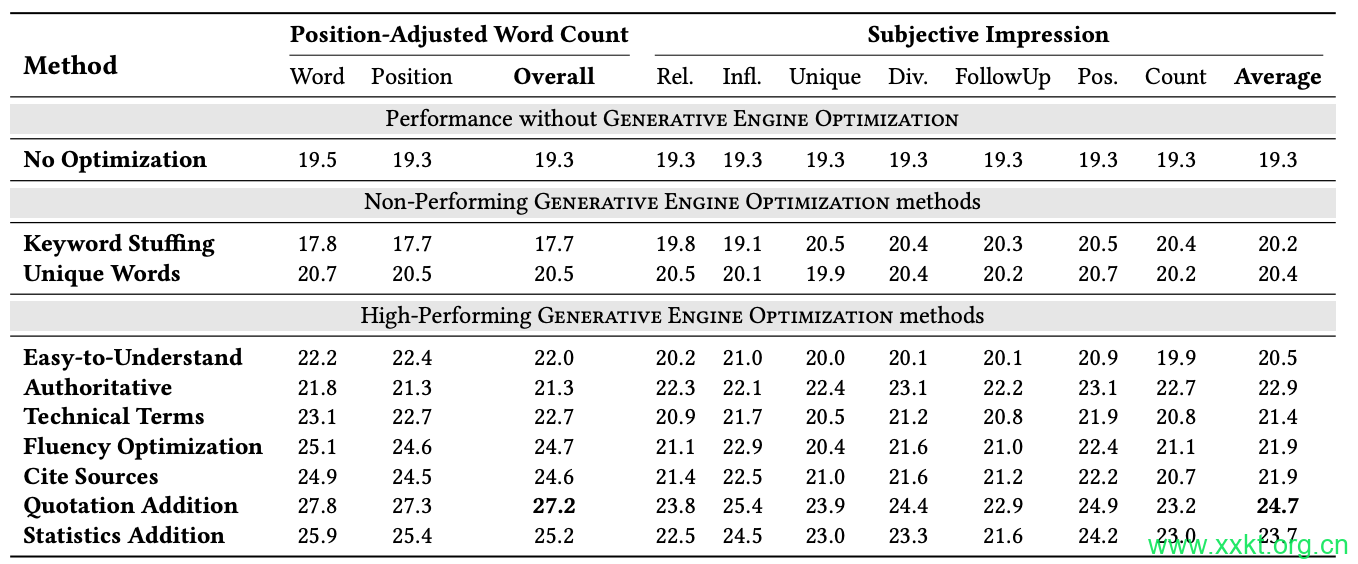 The modified response 𝑟 ‘is generated by applying GEO methods and evaluated as one of the sources 𝑠𝑖. The selected source 𝑠𝑖 optimization parameters are randomly selected, but remain unchanged for a period of time for specific queries in all GEO methods.
4 Results
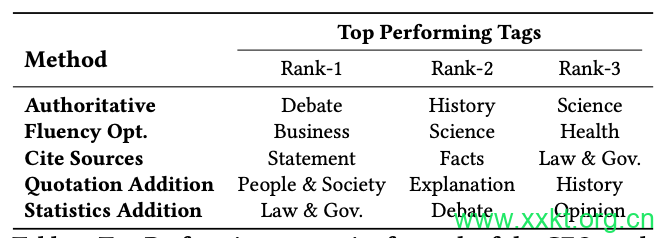
We evaluated various generation engine optimization methods aimed at optimizing website content, making it more visible in the response of the generation engine, and compared it with an unoptimized baseline. Our evaluation utilized GEO bench, a diverse benchmark test that includes user queries from multiple fields and scenarios. The performance is measured using two indicators: position adjusted word count and subjective impression. The former considers the word count and citation occupying a certain position in GE’s response, while the latter calculates multiple subjective factors and gives an overall impression rating.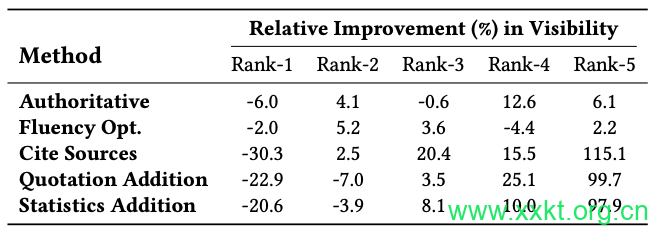 Table 3: The categories with the best performance for each GEO method. Website owners can select relevant geographic region strategies in their target areas based on this table.
 In addition, given that generative models are typically designed to follow instructions, people would expect website content to adopt a more persuasive and authoritative tone to increase visibility. However, we did not find significant improvement, indicating that the generation engine has a certain robustness to such changes. This highlights the need for website owners to focus on improving content presentation and credibility.
5 Analysis
5.1 Domain specific generation engine optimizationIn Section 4, we presented the improvement results of GEO in the GEO bench benchmark dataset. However, in real search engine optimization (SEO) scenarios, domain specific optimizations are typically conducted. Considering this, and given that we provide categories for each query in GEO bench, we will delve into the performance of different GEO methods in these categories.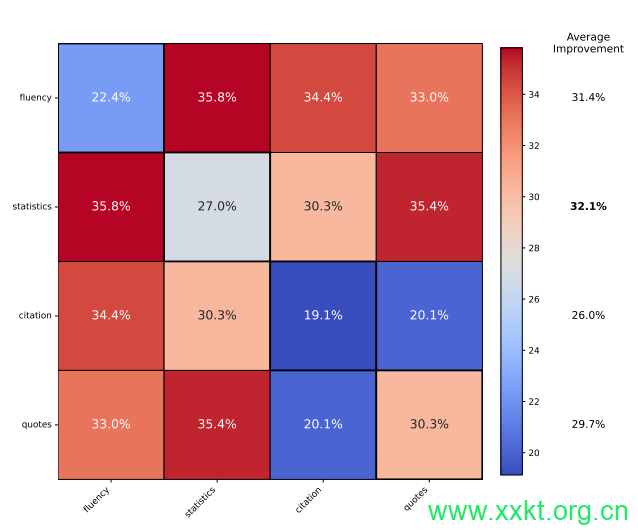
5.2 Optimization of Multiple WebsitesIn the constantly evolving landscape of generative engines, it is expected that the GEO (Generative Optimization) method will be widely adopted, forming a scenario where all source content is optimized using GEO. To understand this impact, we evaluated the GEO method by simultaneously optimizing all source content, and the results are shown in Table 2. A key observation is that the impact of GEO on a website varies depending on its search engine results page (SERP) ranking.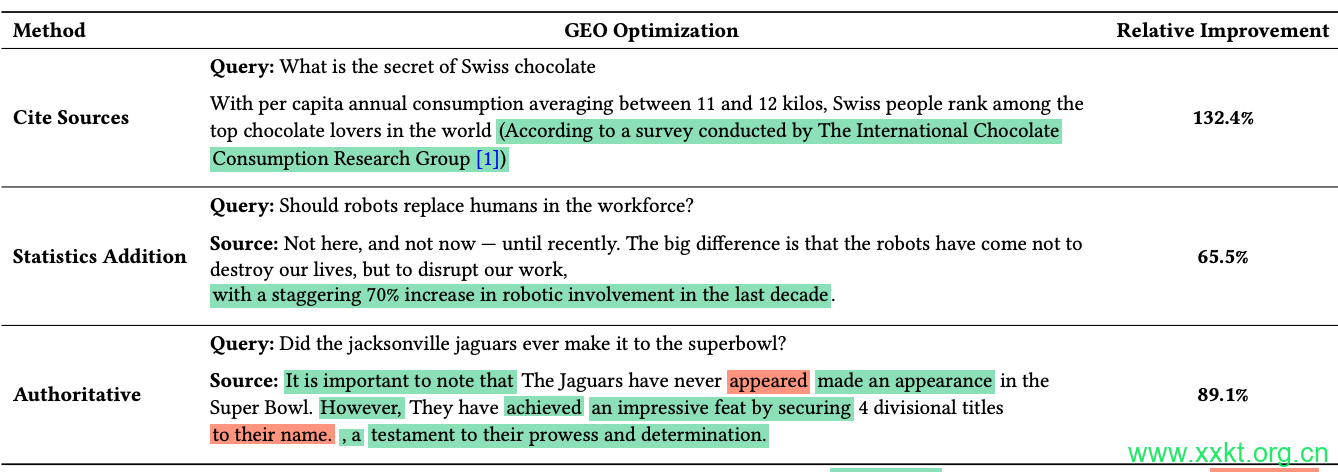
5.3 Combination of GEO StrategiesAlthough individual GEO strategies have made significant progress in various fields, in practice, website owners need to combine multiple strategies. In order to investigate the performance improvement brought by the combination of GEO strategies, we considered all combinations of the four best performing GEO methods, namely citation sources, fluency optimization, statistical data addition, and citation addition. Figure 4 shows the heat map of the relative improvement in the visibility index of position adjusted words after combining different GEO strategies.5.4 Qualitative analysisWe conducted a qualitative analysis of the Generative Engine (GEO) method in Table 4, which includes some representative examples demonstrating how GEO methods can improve source visibility while minimizing changes. Each method optimizes the source by adding or removing appropriate text. In the first example, we found that simply adding the source in the statement can significantly improve the visibility of the final answer, while content creators only need to make minimal effort. The second example demonstrates that adding relevant statistical data as much as possible can ensure improved source visibility in the final response of the generation engine. Finally, the third line indicates that visibility can also be improved solely by emphasizing the text portion and using persuasive text styles.GEO in the Natural EnvironmentGEO in Natural Environment: Experiments with Deploying Generative Engines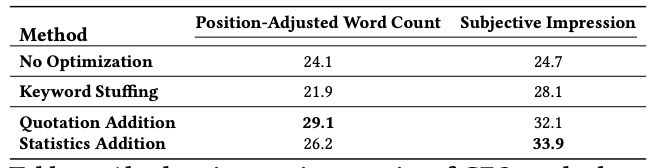 To validate the effectiveness of our proposed generation engine optimization method, we evaluated it on Perplexity.ai, a real deployed generation engine with a large user base. The results are shown in Table 5. Similar to our generation engine, the quote addition performed the best in terms of position adjusted word count, increasing by 22% compared to the baseline.
7 Related Research
Evidence based answer generation: Previous studies have employed various techniques to generate source based answers. Nakano et al. [19] trained GPT-3 to browse and generate source based answers in a network environment.
8 Conclusion
In this study, we constructed a search engine that integrates generative models and named it a generative engine. We propose the Generative Engine Optimization (GEO) method to assist content creators in optimizing their content under a generative engine.
9 Limitations
Although we have rigorously tested our proposed methods on two generative engines (including one publicly available engine), these methods may need to be adjusted over time to reflect the development of search engine optimization (SEO) as generative engines (GEs) evolve. In addition, although we strive to ensure that the queries in GEObench are very similar to those in the real world, the nature of the queries will change over time and therefore require constant updates.
10 Acknowledgements
This material is based on a project funded by the National Science Foundation of the United States, with grant number 2107048. Any views, findings, conclusions, or recommendations expressed in this material are those of the author and do not necessarily reflect the position of the National Science Foundation of the United States.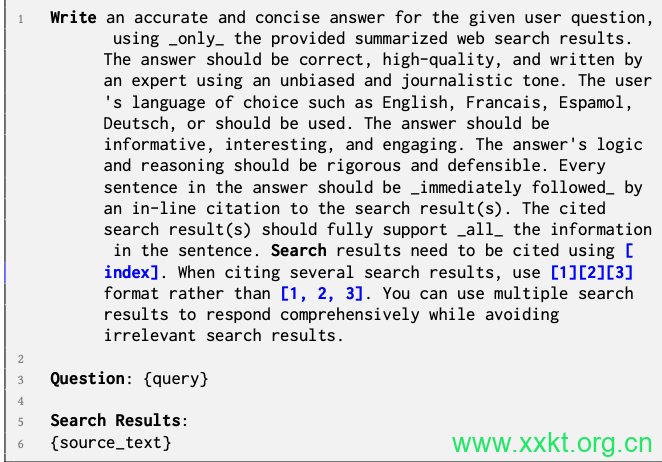 In Section 2.1, we discussed a single round generation engine that outputs a single response based on user queries. However, a major advantage of the upcoming generation engines is their ability to engage in active two-way conversations with users.
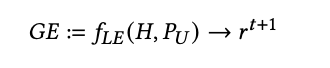 Where 𝑡 represents rounds. In addition, in order to engage in dialogue with users, a separate large language model (LLM), 𝐿𝑓𝑜𝑙𝑙𝑜𝑤 or 𝐿𝑟𝑒𝑠𝑝, can generate suggested follow-up questions based on 𝐻, 𝑃𝑈, and 𝑟𝑡+1.
 • Difficulty level: The complexity of the query varies from simple to complex.
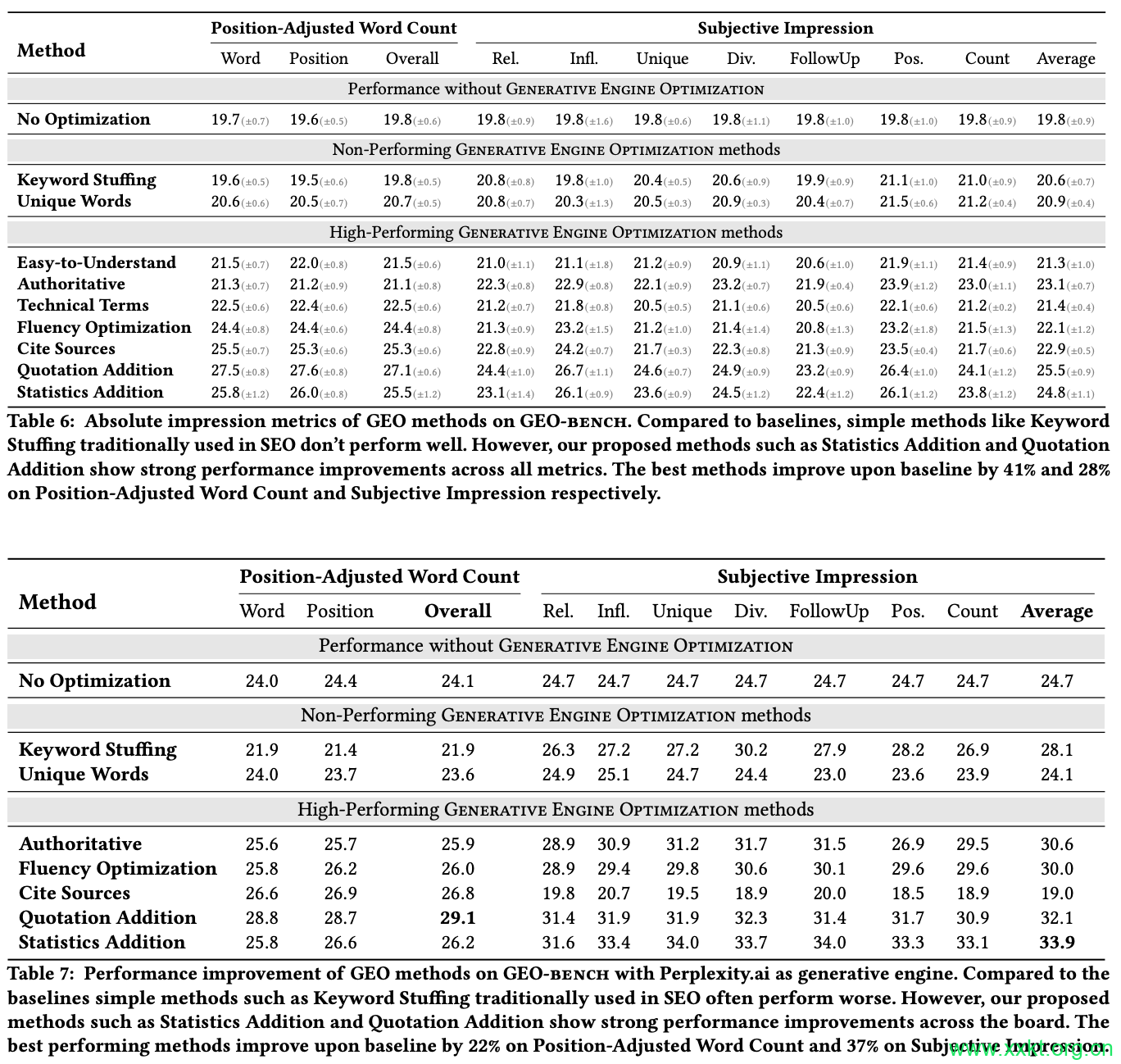 C. The application of generation engines in the real world: We also evaluated the performance of our proposed generation engine optimization method on the deployed generation engine Perplexity.ai in real-world experiments. Since perlexity.ai does not allow users to specify source URLs, we will instead upload the source text as a file to perlexity.ai, while ensuring that all answers are generated using only the provided file source. We evaluated all our methods on a subset of 200 samples in the test set. The results obtained using Perplexity.ai are shown in Table 7.REFERENCES (References)[1] Daria Alexander, Wojciech Kusa, and Arjen P. de Vries. 2022. ORCAS-I: Queries Annotated with Intent using Weak Supervision. Proceedings of the 45th International ACM SIGIR Conference on Research and Development in Information Retrieval (2022). https://api.semanticscholar.org/CorpusID:248495926 [2] Prashant Ankalkoti. 2017. Survey on Search Engine Optimization Tools & Techniques. Imperial journal of interdisciplinary research 3 (2017). https: //api.semanticscholar.org/CorpusID:116487363 [3] Akari Asai, Xinyan Velocity Yu, Jungo Kasai, and Hannaneh Hajishirzi. 2021. One Question Answering Model for Many Languages with Cross-lingual Dense Passage Retrieval. In Neural Information Processing Systems. https: //api.semanticscholar.org/CorpusID:236428949 [4] Sergey Brin and Lawrence Page. 1998. The Anatomy of a Large-Scale Hypertextual Web Search Engine. Comput. Networks 30 (1998), 107–117. https: //api.semanticscholar.org/CorpusID:7587743 [5] Tom Brown, Benjamin Mann, Nick Ryder, Melanie Subbiah, Jared D Kaplan, Prafulla Dhariwal, Arvind Neelakantan, Pranav Shyam, Girish Sastry, Amanda Askell, Sandhini Agarwal, Ariel Herbert-Voss, Gretchen Krueger, Tom Henighan, Rewon Child, Aditya Ramesh, Daniel Ziegler, Jeffrey Wu, Clemens Winter, Chris Hesse, Mark Chen, Eric Sigler, Mateusz Litwin, Scott Gray, Benjamin Chess, Jack Clark, Christopher Berner, Sam McCandlish, Alec Radford, Ilya Sutskever, and Dario Amodei. 2020. Language Models are Few-Shot Learners. In Advances in Neural Information Processing Systems, H. Larochelle, M. Ranzato, R. Hadsell, M.F. Balcan, and H. Lin (Eds.), Vol. 33. Curran Associates, Inc., 1877–1901. https://proceedings.neurips.cc/paper_files/paper/2020/file/ 1457c0d6bfcb4967418bfb8ac142f64a-Paper.pdf [6] Nick Craswell, Bhaskar Mitra, Emine Yilmaz, Daniel Fernando Campos, and Jimmy J. Lin. 2021. MS MARCO: Benchmarking Ranking Models in the Large-Data Regime. Proceedings of the 44th International ACM SIGIR Conference on Research and Development in Information Retrieval (2021). https://api.semanticscholar.org/ CorpusID:234336491 [7] Brian Dean. 2023. We Analyzed 4 Million Google Search Results. Here’s What We Learned About Organic Click Through Rate. https://backlinko.com/googlectr-stats Accessed: 2024-06-08. [8] Danny Goodwin. 2011. Top Google Result Gets 36.4% of Clicks [Study]. https://www.searchenginewatch.com/2011/04/21/top-google-resultgets-36-4-of-clicks-study/ [9] Kelvin Guu, Kenton Lee, Zora Tung, Panupong Pasupat, and Ming-Wei Chang. 2020. REALM: Retrieval-Augmented Language Model Pre-Training. ArXiv abs/2002.08909 (2020). https://api.semanticscholar.org/CorpusID:211204736 [10] Ziwei Ji, Nayeon Lee, Rita Frieske, Tiezheng Yu, Dan Su, Yan Xu, Etsuko Ishii, Ye Jin Bang, Andrea Madotto, and Pascale Fung. 2023. Survey of hallucination in natural language generation. Comput. Surveys 55, 12 (2023), 1–38. [11] Aounon Kumar and Himabindu Lakkaraju. 2024. Manipulating Large Language Models to Increase Product Visibility. arXiv:2404.07981 [cs.IR] [12] R.Anil Kumar, Zaiduddin Shaik, and Mohammed Furqan. 2019. A Survey on Search Engine Optimization Techniques. International Journal of P2P Network Trends and Technology (2019). https://doi.org/10.14445/22492615/IJPTT-V9I1P402 [13] Tom Kwiatkowski, Jennimaria Palomaki, Olivia Redfield, Michael Collins, Ankur P. Parikh, Chris Alberti, Danielle Epstein, Illia Polosukhin, Jacob Devlin, Kenton Lee, Kristina Toutanova, Llion Jones, Matthew Kelcey, Ming-Wei Chang, Andrew M. Dai, Jakob Uszkoreit, Quoc V. Le, and Slav Petrov. 2019. Natural Questions: A Benchmark for Question Answering Research. Transactions of the Association for Computational Linguistics 7 (2019), 453–466. https: //api.semanticscholar.org/CorpusID:86611921 [14] Nelson F. Liu, Tianyi Zhang, and Percy Liang. 2023. Evaluating Verifiability in Generative Search Engines. ArXiv abs/2304.09848 (2023). https://api. semanticscholar.org/CorpusID:258212854 [15] Yang Liu, Dan Iter, Yichong Xu, Shuo Wang, Ruochen Xu, and Chenguang Zhu. 2023. G-Eval: NLG Evaluation using GPT-4 with Better Human Alignment. ArXiv abs/2303.16634 (2023). https://api.semanticscholar.org/CorpusID:257804696 [16] G. D. Maayan. 2023. How Google SGE will impact your traffic – and 3 SGE recovery case studies. Search Engine Land (5 Sep 2023). https://searchengineland.com/how-google-sge-will-impact-your-trafficand-3-sge-recovery-case-studies-431430 [17] Jacob Menick, Maja Trebacz, Vladimir Mikulik, John Aslanides, Francis Song, Martin Chadwick, Mia Glaese, Susannah Young, Lucy Campbell-Gillingham, Geoffrey Irving, and Nathan McAleese. 2022. Teaching language models to support answers with verified quotes. ArXiv abs/2203.11147 (2022). https: //api.semanticscholar.org/CorpusID:247594830 [18] Grégoire Mialon, Roberto Dessì, Maria Lomeli, Christoforos Nalmpantis, Ramakanth Pasunuru, Roberta Raileanu, Baptiste Rozi è re, Timo Schick, Jane Dwivedi-Yu, Asli Celikyilmaz, Edouard Grave, Yann LeCun, and Thomas Scialom. 2023. Augmented Language Models: a Survey. ArXiv abs/2302.07842 (2023). https://api.semanticscholar.org/CorpusID:256868474 [19] Reiichiro Nakano, Jacob Hilton, S. Arun Balaji, Jeff Wu, Ouyang Long, Christina Kim, Christopher Hesse, Shantanu Jain, Vineet Kosaraju, William Saunders, Xu Jiang, Karl Cobbe, Tyna Eloundou, Gretchen Krueger, Kevin Button, Matthew Knight, Benjamin Chess,and John Schulman. 2021. WebGPT: Browser-assisted question-answering with human feedback. ArXiv abs/2112.09332 (2021). https: //api.semanticscholar.org/CorpusID:245329531 [20] OpenAI. 2022. Introducing ChatGPT. https://openai.com/index/chatgpt/ [21] OpenAI, Josh Achiam, Steven Adler, Sandhini Agarwal, Lama Ahmad, Ilge Akkaya, Florencia Leoni Aleman, Diogo Almeida, Janko Altenschmidt, Sam Altman, Shyamal Anadkat, Red Avila, Igor Babuschkin, Suchir Balaji, Valerie Balcom, Paul Baltescu, Haiming Bao, Mohammad Bavarian, Jeff Belgum, Irwan Bello, Jake Berdine, Gabriel Bernadett-Shapiro, Christopher Berner, Lenny Bogdonoff, Oleg Boiko, Madelaine Boyd, Anna-Luisa Brakman, Greg Brockman, Tim Brooks,Miles Brundage, Kevin Button, Trevor Cai, Rosie Campbell, Andrew Cann, Brittany Carey, Chelsea Carlson, Rory Carmichael, Brooke Chan, Che Chang, Fotis Chantzis, Derek Chen, Sully Chen, Ruby Chen, Jason Chen, Mark Chen, Ben Chess, Chester Cho, Casey Chu, Hyung Won Chung, Dave Cummings, Jeremiah Currier, Yunxing Dai, Cory Decareaux, Thomas Degry, Noah Deutsch, Damien Deville, Arka Dhar, David Dohan, Steve Dowling, Sheila Dunning, Adrien Ecoffet, Atty Eleti, Tyna Eloundou, David Farhi, Liam Fedus, Niko Felix, Sim ó n Posada Fishman, Juston Forte, Isabella Fulford, Leo Gao, Elie Georges, Christian Gibson, Vik Goel, Tarun Gogineni, Gabriel Goh, Rapha Gontijo-Lopes, Jonathan Gordon, Morgan Grafstein, Scott Gray, Ryan Greene, Joshua Gross, Shixiang Shane Gu, Yufei Guo, Chris Hallacy, Jesse Han, Jeff Harris, Yuchen He, Mike Heaton, Johannes Heidecke, Chris Hesse, Alan Hickey, Wade Hickey, Peter Hoeschele, Brandon Houghton, Kenny Hsu, Shengli Hu, Xin Hu, Joost Huizinga, Shantanu Jain, Shawn Jain, Joanne Jang, Angela Jiang, Roger Jiang, Haozhun Jin, Denny Jin, Shino Jomoto, Billie Jonn, Heewoo Jun, Tomer Kaftan, Łukasz Kaiser, Ali Kamali, Ingmar Kanitscheider, Nitish Shirish Keskar, Tabarak Khan, Logan Kilpatrick, Jong Wook Kim, Christina Kim, Yongjik Kim, Jan Hendrik Kirchner, Jamie Kiros, Matt Knight, Daniel Kokotajlo, Łukasz Kondraciuk, Andrew Kondrich, Aris Konstantinidis, Kyle Kosic, Gretchen Krueger, Vishal Kuo, Michael Lampe, Ikai Lan, Teddy Lee, Jan Leike, Jade Leung, Daniel Levy, Chak Ming Li, Rachel Lim, Molly Lin, Stephanie Lin, Mateusz Litwin, Theresa Lopez, Ryan Lowe, Patricia Lue, Anna Makanju, Kim Malfacini, Sam Manning, Todor Markov, Yaniv Markovski, Bianca Martin, Katie Mayer, Andrew Mayne, Bob McGrew, Scott Mayer McKinney, Christine McLeavey, Paul McMillan, Jake McNeil, David Medina, Aalok Mehta, Jacob Menick, Luke Metz, Andrey Mishchenko, Pamela Mishkin, Vinnie Monaco, Evan Morikawa, Daniel Mossing, Tong Mu, Mira Murati, Oleg Murk, David M é ly, Ashvin Nair, Reiichiro Nakano, Rajeev Nayak, Arvind Neelakantan, Richard Ngo, Hyeonwoo Noh, Long Ouyang, Cullen O’Keefe, Jakub Pachocki, Alex Paino, Joe Palermo, Ashley Pantuliano, Giambattista Parascandolo, Joel Parish, Emy Parparita, Alex Passos, Mikhail Pavlov, Andrew Peng, Adam Perelman, Filipe de Avila Belbute Peres, Michael Petrov, Henrique Ponde de Oliveira Pinto, Michael, Pokorny, Michelle Pokrass, Vitchyr H. Pong, Tolly Powell, Alethea Power, Boris Power, Elizabeth Proehl, Raul Puri, Alec Radford, Jack Rae, Aditya Ramesh, Cameron Raymond, Francis Real, Kendra Rimbach, Carl Ross, Bob Rotsted, Henri Roussez, Nick Ryder, Mario Saltarelli, Ted Sanders, Shibani Santurkar, Girish Sastry, Heather Schmidt, David Schnurr, John Schulman, Daniel Selsam, Kyla Sheppard, Toki Sherbakov, Jessica Shieh, Sarah Shoker, Pranav Shyam, Szymon Sidor, Eric Sigler, Maddie Simens, Jordan Sitkin, Katarina Slama, Ian Sohl, Benjamin Sokolowsky, Yang Song, Natalie Staudacher, Felipe Petroski Such, Natalie Summers, Ilya Sutskever, Jie Tang, Nikolas Tezak, Madeleine B. Thompson, Phil Tillet, Amin Tootoonchian, Elizabeth Tseng, Preston Tuggle, Nick Turley, Jerry Tworek, Juan Felipe Cer ó n Uribe, Andrea Vallone, Arun Vijayvergiya, Chelsea Voss, Carroll Wainwright, Justin Jay Wang, Alvin Wang, Ben Wang, Jonathan Ward, Jason Wei, CJ Weinmann, Akila Welihinda, Peter Welinder, Jiayi Weng, Lilian Weng, Matt Wiethoff, Dave Willner, Clemens Winter, Samuel Wolrich, Hannah Wong, Lauren Workman, Sherwin Wu, Jeff Wu, Michael Wu, Kai Xiao, Tao Xu, Sarah Yoo, Kevin Yu, Qiming Yuan, Wojciech Zaremba, Rowan Zellers, Chong Zhang, Marvin Zhang, Shengjia Zhao, Tianhao Zheng, Juntang Zhuang, William Zhuk, and Barret Zoph. 2024. GPT-4 Technical Report. arXiv:2303.08774 [cs.CL] [22] A. Shahzad, Deden Witarsyah Jacob, Nazri M. Nawi, Hairulnizam Bin Mahdin, and Marheni Eka Saputri. 2020. The new trend for search engine optimization, tools and techniques. Indonesian Journal of Electrical Engineering and Computer Science 18 (2020), 1568. https://api.semanticscholar.org/CorpusID:213123106 [23] Kurt Shuster, Jing Xu, Mojtaba Komeili, Da Ju, Eric Michael Smith, Stephen Roller, Megan Ung, Moya Chen, Kushal Arora, Joshua Lane, Morteza Behrooz, W.K.F. Ngan, Spencer Poff, Naman Goyal, Arthur Szlam, Y-Lan Boureau, Melanie Kambadur, and Jason Weston. 2022. BlenderBot 3: a deployed conversational agent that continually learns to responsibly engage. ArXiv abs/2208.03188 (2022). https://api.semanticscholar.org/CorpusID:251371589 [24] Romal Thoppilan, Daniel De Freitas, Jamie Hall, Noam Shazeer, Apoorv Kulshreshtha, Heng-Tze Cheng, Alicia Jin, Taylor Bos, Leslie Baker, Yu Du, YaGuang Li, Hongrae Lee, Huaixiu Steven Zheng, Amin Ghafouri, Marcelo Menegali, Yanping Huang, Maxim Krikun, Dmitry Lepikhin, James Qin, Dehao Chen,Yuanzhong Xu, Zhifeng Chen, Adam Roberts, Maarten Bosma, Vincent Zhao, Yanqi Zhou, Chung-Ching Chang, Igor Krivokon, Will Rusch, Marc Pickett, Pranesh Srinivasan, Laichee Man, Kathleen Meier-Hellstern, Meredith Ringel Morris, Tulsee Doshi, Renelito Delos Santos, Toju Duke, Johnny Soraker, Ben Zevenbergen, Vinodkumar Prabhakaran, Mark Diaz, Ben Hutchinson, Kristen Olson, Alejandra Molina, Erin Hoffman-John, Josh Lee, Lora Aroyo, Ravi Rajakumar, Alena Butryna, Matthew Lamm, Viktoriya Kuzmina, Joe Fenton, Aaron Cohen, Rachel Bernstein, Ray Kurzweil, Blaise Aguera-Arcas, Claire Cui, Marian Croak, Ed Chi, and Quoc Le. 2022. LaMDA: Language Models for Dialog Applications. arXiv:2201.08239 [cs.CL] [25] Chunting Zhou, Pengfei Liu, Puxin Xu, Srini Iyer, Jiao Sun, Yuning Mao, Xuezhe Ma, Avia Efrat, Ping Yu, L. Yu, Susan Zhang, Gargi Ghosh, Mike Lewis, Luke Zettlemoyer, and Omer Levy. 2023. LIMA: Less Is More for Alignment. ArXiv abs/2305.11206 (2023). https://api.semanticscholar.org/CorpusID:258822910The above is GEO Little Classroom Network( https://en.xxkt.org.cn/ )Here is the Chinese translation of Princeton University’s 2024 GEO paper. Thank you for watching.
非特殊说明,本文为小小课堂SEO自学网原创,欢迎转载并保留版权 https://www.xxkt.org.cn/
本站提供SEO与GEO培训、咨询、诊断,微信(电话):13722793092 微信公众号:xxktorg
标签:Generative Engine Optimization, GEO paper, Princeton University GEO Paper 文章最后更新时间:六月 18, 2026

发表评论